After the doors lock and employees leave, a property can enter a vulnerable period. Lots grow quiet, reception areas sit unattended and a damaged fence or suspicious vehicle may go unnoticed until morning. If something happens after hours, how quickly would your team know, confirm what’s happening and respond?
This guide from SafeTouch explores how to prevent theft and vandalism at commercial properties. It examines live video monitoring, exterior lighting, access control and on-site security, while showing how these measures can work together as part of a layered strategy.
Key Takeaways
Effective after-hours security combines visibility, controlled access, human oversight and appropriate response. Look for these features in a business security system:
- Layer security: Combine cameras, an alarm and a monitoring system to move beyond passive detection.
- Analyze activity: Use AI-assisted analytics to identify activity that needs human review.
- Use agents: Give trained monitoring agents the ability to issue live audio warnings.
- Set procedures: Establish clear escalation procedures when warnings do not resolve threats.
- Install lighting: Use exterior lighting to improve visibility around vulnerable areas.
- Access control: Verify the identity of unexpected visitors and vendors before granting after-hours access.
- Maintain records: Keep digital access records that support accountability and investigations.
Why Do Theft and Vandalism Happen After Hours?
Commercial properties naturally have more activity during operating hours. Employees arrive, customers move through entrances and vendors make scheduled deliveries. That activity creates more visibility across the property. People may notice an unfamiliar vehicle, an open door or someone entering an area without authorization. After closing, much of that visibility disappears, and there are fewer witnesses to a potential crime.
Once activity slows down, suspicious behavior becomes easier to overlook. Criminals are opportunistic and deliberate about timing. For someone attempting unauthorized access, those conditions create a chance to approach without immediate attention.
Commercial properties face different after-hours risks depending on their operations and physical layout. A retailer may have merchandise near accessible entrances, while a warehouse may store valuable inventory. An office building presents different considerations. Computers, records and equipment may remain inside long after employees have gone home.
A centralized security strategy can help teams maintain consistent oversight, whether they are running one or multiple locations, without requiring someone to remain physically present at the property.
Business Impacts Extend Beyond the Incident
For business owners, the immediate loss is only part of the problem. Damage discovered in the morning can delay opening, disrupt employees and force managers to shift their attention from daily operations to recovery.
A damaged entrance may require urgent repairs before customers can enter, and stolen equipment can interrupt production or prevent employees from completing essential tasks. Even relatively minor vandalism can create unexpected repair costs and leave employees feeling unsafe.
These disruptions can also affect customers. A business that repeatedly experiences operational interruptions may struggle to provide the consistent experience customers expect. This makes after-hours security an operational consideration. Limiting incidents helps businesses protect continuity and physical property.
What Are the Limitations of Traditional Alarms and Cameras?
Alarms and security cameras are fundamental components of business security. Commercial security cameras provide visibility and can preserve valuable evidence. Alarm systems can identify specific events and notify designated contacts or monitoring centers.
The problem is that detection alone does not always lead to fast action. That makes these systems purely reactive tools when used on their own. Their value depends on what happens after the system captures activity. Limitations may include:
- Recording crimes: While cameras preserve valuable evidence, recording does not physically intervene during an incident. Footage may help identify what happened after the event.
- Police clearance gap: Law enforcement cannot respond to every alarm as a verified crime in progress. False or unverified alerts can affect how incidents are prioritized and handled.
- False activations: Alarms may be triggered by authorized activity, environmental conditions or other non-threatening events. Frequent false activations can create unnecessary demands for responders.
These limitations do not make cameras and alarms ineffective. They show opportunities for businesses to benefit from adding verification and response capabilities. For a business managing employees, customers and daily operations, partnering with a security service provider to add live monitoring to its surveillance and alarm systems can strengthen its after-hours security posture.
How Does Live Video Monitoring Help Deter Threats?
Security becomes more proactive when technology alerts trained professionals while an incident is still unfolding. Live video monitoring adds that human decision-making layer, as the monitoring team can assess an alert while activity is occurring. That gives your team a better chance to stop suspicious activity before it leads to damage, theft or bigger costs.
Real Time Virtual Guard Services
Virtual guard services combine security technology with trained monitoring professionals. Reducing uncertainty during an incident with virtual guard services means having trained personnel assess the situation using established procedures. This creates a clear chain from detection to decision-making.
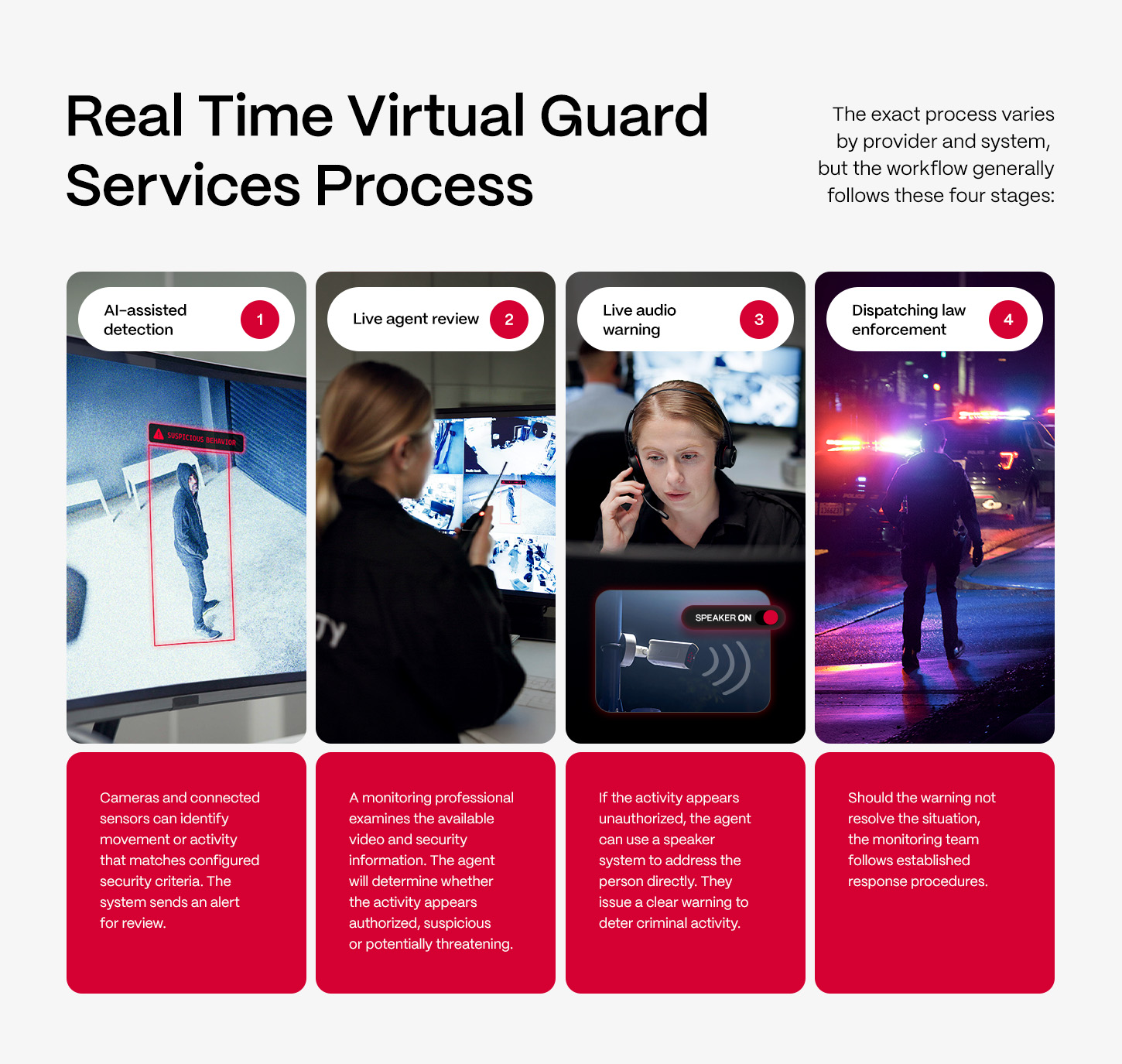
The exact process varies by provider and system, but the workflow generally follows these four stages:
- AI-assisted detection: Cameras and connected sensors can identify movement or activity that matches configured security criteria. The system sends an alert for review.
- Live agent review: A monitoring professional examines the available video and security information. The agent will determine whether the activity appears authorized, suspicious or potentially threatening.
- Live audio warning: If the activity appears unauthorized, the agent can use a speaker system to address the person directly. They issue a clear warning to deter criminal activity.
- Dispatching law enforcement: Should the warning not resolve the situation, the monitoring team follows established response procedures.
Clear procedures can specify which events require audio warnings, escalation or emergency notification. This reduces uncertainty, helping monitoring teams act consistently. Live monitoring can also help reduce unnecessary escalation, as human review provides context that an automated alert alone may not. That distinction matters when businesses need to separate routine activity from a genuine security concern.
Lighting For After-Hours Protection
Exterior lighting is a foundational security layer that works alongside cameras and live monitoring. Good lighting can improve visibility around areas where people, vehicles and entry points need to be observed. Lighting illuminates doors, gates, parking areas, loading zones, walkways and exterior spaces. Better visibility can make suspicious activity easier to detect and identify. Lighting also supports camera performance, improving information quality, particularly at critical entry points.
Businesses can combine fixed exterior lighting with security cameras and monitoring. Some properties may also use motion-activated lighting in selected areas. When activity triggers a light, the sudden increase in visibility can draw attention to movement and support video verification.
Working With an Experienced Security Provider
For businesses considering live video monitoring, choosing the right security partner matters as much as selecting the right technology. An experienced provider helps assess the property, identify coverage gaps and develop procedures suited to its operating environment.
The right professional monitoring teams will also have clear processes for verifying alerts, communicating with people on-site and escalating incidents when necessary. Businesses can also use access control solutions to form a holistic security strategy. This gives businesses access to technical expertise, monitoring capabilities and ongoing support from security professionals.
How Does Access Control Support After-Hours Security?
Access control is most effective when it forms part of a layered security strategy. It determines who can enter a building or property, when they can enter and which areas they can access.
During business hours, access control can manage employees, contractors and authorized visitors. After hours, it becomes an important boundary between legitimate access and unauthorized entry.
A guard-managed approach adds human oversight to these perimeters. Monitoring professionals can help verify unusual access attempts and manage connected entry points when the system supports remote access.
Remote Gate and Door Control
Remote gate and door control can help businesses manage physical entry points without requiring a guard to stand at every entrance. Businesses can assign time-based access permissions according to employee schedules, operating hours or specific job requirements. For example, an employee may have access during a scheduled overnight shift but lose that permission after the shift ends.
Virtual guards or monitoring agents may also control connected doors and gates in accordance with established procedures. This can help manage unexpected requests while maintaining centralized oversight.
Verifying Visitors and Vendors After Hours
Not every after-hours visitor is a threat. Contractors may need to repair equipment, cleaning crews have scheduled access or delivery drivers may arrive outside of normal operating hours.
Access policies should also include exceptions. An employee may need to enter unexpectedly due to equipment failure or urgent maintenance issues. Verification helps accommodate legitimate needs without treating every unexpected arrival as authorized by default. The challenge is distinguishing legitimate activity from unauthorized access.
These systems can maintain digital audit trails of access logs, entry times, access points, the credentials used and other available system information. This supports accountability and can help investigators reconstruct events after an incident.
When Are On-Site Guards the Right Choice?
On-site guards are a good option for properties that require a physical security presence. But the choice to add on-site guards depends on the property’s risk profile, operating environment and security objectives. Some businesses may need personnel to patrol large sites, monitor sensitive areas or physically respond to incidents. Others might want a visible security presence because of customer activity, valuable assets or specific site conditions.
However, physical guarding need not operate separately from technology. A hybrid approach can combine on-site guards with virtual monitoring. For example, live monitoring offers continuous oversight across key points in the property, while an on-site guard handles physical response. Monitoring personnel can also help direct attention toward a specific location when an alert occurs.
This layered model can extend a security team’s reach. Instead of asking one guard to continuously monitor every area, businesses can use technology to enhance awareness and human personnel to provide physical intervention where needed. The right setup depends on the property, the risks and how much support your team needs after hours. A small, low-activity site may need a different approach from a large distribution center, manufacturing facility or multi-building campus.
How Can Businesses Build a Layered After-Hours Security Strategy?
After-hours security works best when each layer has a clear purpose and builds on the next. For instance, cameras provide visibility, alarms identify potential events, live monitoring adds verification, and guards can offer physical intervention when needed.
No single measure addresses every scenario — a layered strategy integrates detection, deterrence, access management and response into a single plan. Businesses should assess their property, identify vulnerable areas and select tools that fit their operations.
A well-designed after-hours security plan gives commercial managers better visibility and a clearer response path when the property is closed. Every part of a commercial property carries its own security requirements.
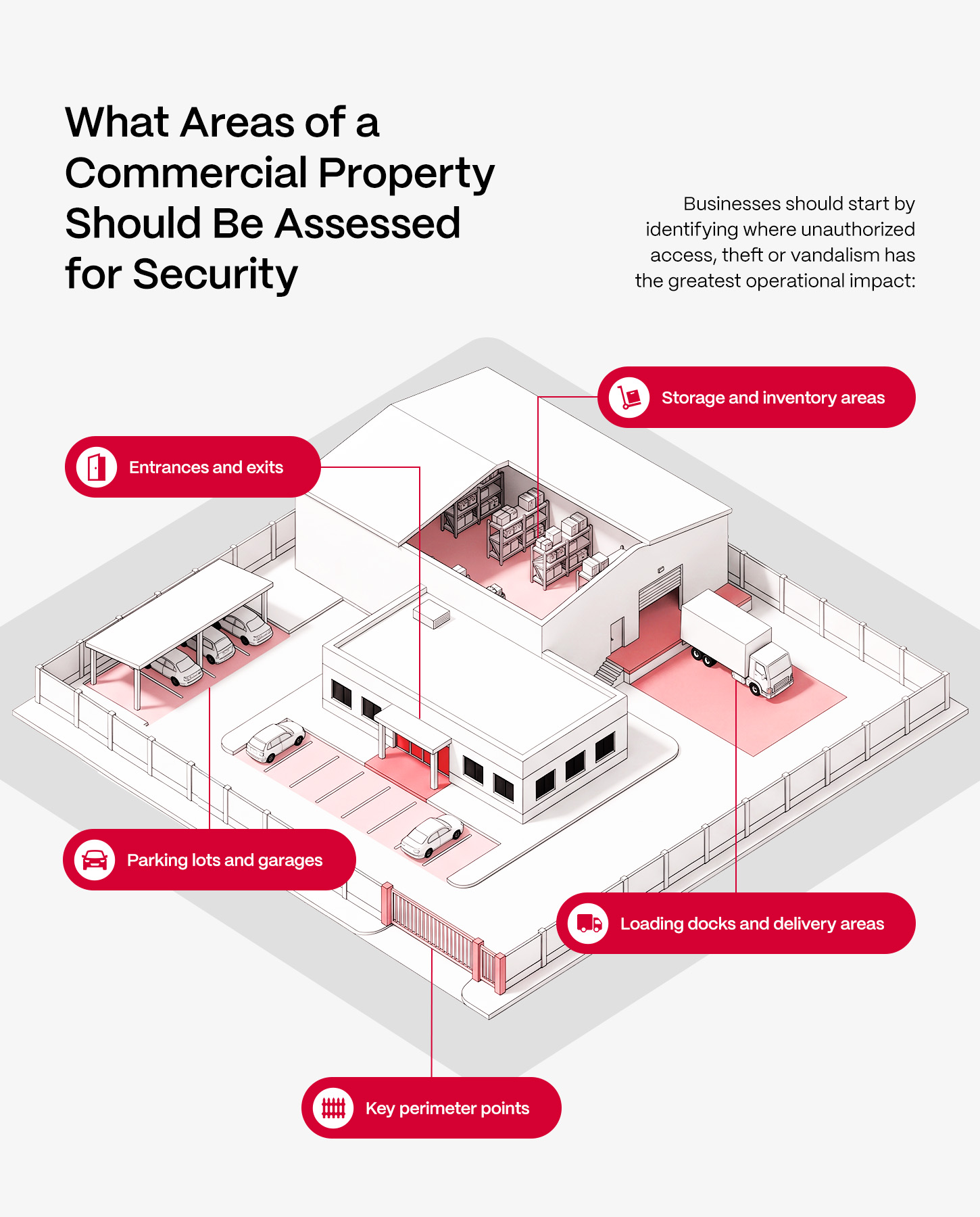
Businesses should start by identifying where unauthorized access, theft or vandalism has the greatest operational impact:
- Entrances and exits: Main doors, employee entrances and emergency exits can become access points when normal foot traffic stops. Cameras, controlled access and appropriate lighting can help businesses maintain visibility around these areas.
- Loading docks and delivery areas: These spaces often have larger doors, vehicle access and scheduled activity outside standard business hours. Clear procedures can help distinguish expected deliveries from unauthorized activity.
- Parking lots and garages: Employees may arrive or leave outside normal hours, while vehicles and pedestrians can move through areas that receive limited oversight.
- Storage and inventory areas: Areas containing high-value products, equipment or sensitive materials should have additional access point permissions to restrict these areas to authorized personnel.
- Key perimeter points: Fences, gates, rear entrances and less visible sides of a property can create opportunities for unauthorized access, especially when they fall outside camera coverage.
Prioritize Protecting Your Commercial Property After Hours
A useful security assessment should look beyond the main entrance. Businesses can map how people, vehicles and deliveries move through the property after hours. This helps identify where additional security measures to prevent business theft and vandalism will deliver the greatest benefit, informing a sound after-hours security strategy.
A layered after-hours security plan can help commercial properties improve visibility, support faster verification and create a clearer response path when suspicious activity occurs. By combining the right tools and procedures, businesses can take a more proactive approach to reducing theft, vandalism and other after-hours risks.